Most Wineries Are Pricing Wine Without Knowing What It Costs
If you’ve ever tried to figure out what a single case of wine actually cost to make, pulling numbers from QuickBooks, a few spreadsheets, and whatever the cellar team wrote down, you already know how hard it is to land on a number you trust.
You’re not alone. Our 2026 State of Winery Health Report found that 43% of wineries set prices without knowing the margin on each wine. And the wineries that do track profit per wine are more than twice as likely to be profitable.
So we asked a CFO, a winery accountant, and our head of enterprise sales one question: where does costing go wrong, and how do you fix it?
Panelists included:
- Trycel Alvarez-Pihl (CFO, Darioush)
- Zane Stevens (Founder, Protea Financial)
- Emma Fladeboe (Head of Enterprise Sales, InnoVint)
Their conversation came down to four takeaways every winery can use:
- Year-end is too late to find out what your wine costs
- Averages and old standards hide your real margins
- When you know your costs, you make better decisions
- Accurate costs protect the value of your winery
Check out the highlights below, or watch the full recording on demand here.
Takeaway #1: Year-End Is Too Late to Find Out
For Trycel, the biggest problem is timing. Most wineries don’t look closely at their costs until the year is over, and by then it’s too late to do anything about them.
If you’re looking at things at year-end, you don’t have enough time to make a decision or to know how your strategic decisions are being affected by your costs. That’s why it’s so important to make sure you’re putting the effort in, incorporating it into your monthly process to assess your costs.
Trycel Alvarez-Pihl (CFO, Darioush)
Emma hears a version of this in almost every conversation with winery finance teams. Costs live wherever they happened to land, some in the general ledger, some in Excel, some in a production system, and pulling them together takes so long that it rarely gets done. She recently worked with a portfolio winery where several people spent about a month just tying harvest receipts back to the blocks the fruit came from.
“‘Accurate enough’ tends to be the phrase that I hear the most,” Emma states.
The takeaway: Build costing into your monthly close. If your first real look at costs happens at year-end, the decisions it should have informed have already been made.
Takeaway #2: Averages and Old Standards Hide Your Real Margins
A lot of wineries spread their costs evenly across every wine. Zane calls it “peanut butter spreading,” and while he’s quick to celebrate any winery that’s tracking costs at all, he explained why it falls short with an example from the vineyard:
I’ve got grapes that I’m farming up on a hillside. I’ve got some that are in the valley. The valley, I can take a machine out there, it’ll pick all my grapes. It costs me no labor. But the ones up on the hillside, I actually need people to go pick. Well, if I’m allocating that labor to all my grapes, that’s not fair to the ones in the valley, and it’s definitely underestimating the cost of the ones on the hillside.
Zane Stevens (Founder, Protea Financial)
The same thing happens with your whites and reds. If a white releasing this spring carries the same cost as a red that will age for three years, your red margins look better than they are and your white margins look worse.
Standard costing has its own trap. “A glass bottle today is not what it cost five years ago,” Zane pointed out. When standards don’t get updated, the difference quietly piles up on the balance sheet. One winery he worked with had to write off $250,000 in glass that didn’t exist, because nobody had ever accounted for bottles breaking during bottling. Over ten years, it added up.
The cost of a wine should follow that wine. Allocate labor and overhead based on where the work actually happened, and update your standard costs every year.
Takeaway #3: When You Know Your Costs, You Make Better Decisions
Accurate costs don’t tell you what to charge, but they change the conversations you can have. Trycel shared how Darioush operated before the team could see its margins clearly:
We were pushing wine into wholesale channels because there was excess inventory, not necessarily because it was the best strategic decision. If the team would’ve known the margin years ago, they might have made a different strategic decision in which channel they would’ve pushed different wines.
Trycel Alvarez-Pihl (CFO, Darioush)
Knowing your numbers also gives you the freedom to make choices on purpose. Zane has clients who know a wine only makes them a dollar a bottle and keep making it anyway, because they love it and their direct-to-consumer customers love it too. The difference is they know.
He’s also seen the other side. One winery’s top distribution SKU, about 70% of its volume, was losing money on every case after an expensive varietal went into the blend. By the time Zane’s team ran the numbers, the winery was already in liquidation. (When the conversation turned to killing the messenger, Zane just laughed: “Oh, I’m used to it.”)
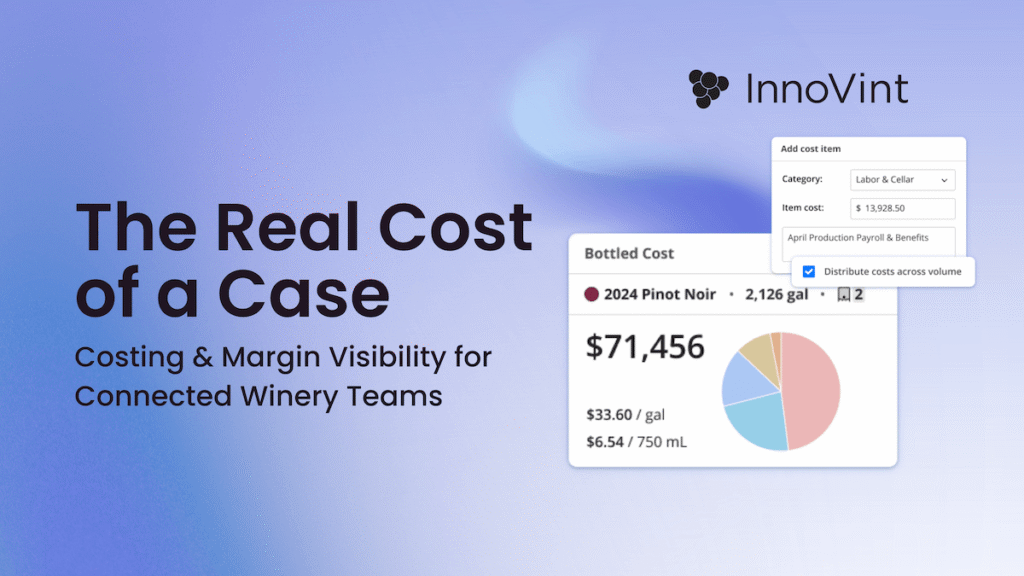
And costing doesn’t have to pit finance against the cellar. “It’s not finance coming in and telling winemaking what needs to happen,” Trycel said. “It’s showing the data and saying, ‘Hey, here are the options.'” With blend trial costing in InnoVint, winemakers see what each blend version costs right alongside the quality decision.
Know your margin by SKU before you choose a channel, approve a discount, or commit to a blend. Then any trade-off you make is a choice, not a surprise.
Takeaway #4: Accurate Costs Protect the Value of Your Winery
Costing matters well beyond the P&L. Banks want to know what your wine costs, and if you ever sell, buyers will ask first. Zane put it bluntly: “If your inventory is worth $0 on your balance sheet, $0 times any multiple is still $0.”
That’s where defensible reports come in. Trycel spent most of her career building cost roll forward reports by hand, until her previous winery moved its costing into InnoVint:
My whole career I’ve been building these in Excel and having to go back and figure out which bulk lots got blended and where. Being able to click a button at the end of the year and have a bulk roll forward was a game changer, and it added the credibility to our bank, to everyone.
Trycel Alvarez-Pihl (CFO, Darioush)
If you might ever borrow money or sell your winery, costs you can defend are what protect its value.
What This Means for Your Winery
If there was one thing the whole panel agreed on, it’s that you don’t need a perfect system to get started:
- Reconcile your year-end bulk balance to your lots, so you know your cost per lot (Trycel)
- Start with something, even a basic costing, and build from there (Zane)
- Name the decisions you want your numbers to inform, then choose the process and systems to support them (Emma)
And when we asked what the panel would tell finance teams still working in spreadsheets, Trycel didn’t hesitate:
Please, please look into InnoVint… The nice thing about InnoVint is that the costing is built on top of all the wine movements. The winemaking team does all their work orders… and then I go in and do the costing. It doesn’t interfere in any way… I could never go backwards from here.
Trycel Alvarez-Pihl (CFO, Darioush)
Zane made the case from the accounting side, and for compliance too. Handwritten cellar records are tough to defend in an audit, and as he told the audience, “a lot of you should have been doctors the way you write.”
If you’re closing out harvest and starting to think about 2027 budgets, grab Trycel’s Costing Diagnostic Worksheet, or talk to our team about what costing could look like at your winery.